

- The Dow Jones took a meager step upward on Thursday, clawing into record highs.
- The tech sector is taking the biggest step, bolstered by the ongoing AI rally.
- The Fed’s rate cut and tease of more cuts to come has lifted investor sentiment.
The Dow Jones Industrial Average (DJIA) rose on renewed bullish sentiment across broader markets on Thursday, bolstered by the Federal Reserve’s (Fed) decision to cut interest rates for the first time in nine months. The tech rally has extended its legs, both on the hope that declining interest rates will reinvigorate business investment across the space, as well as a new investment pivot by major players in the AI segment.
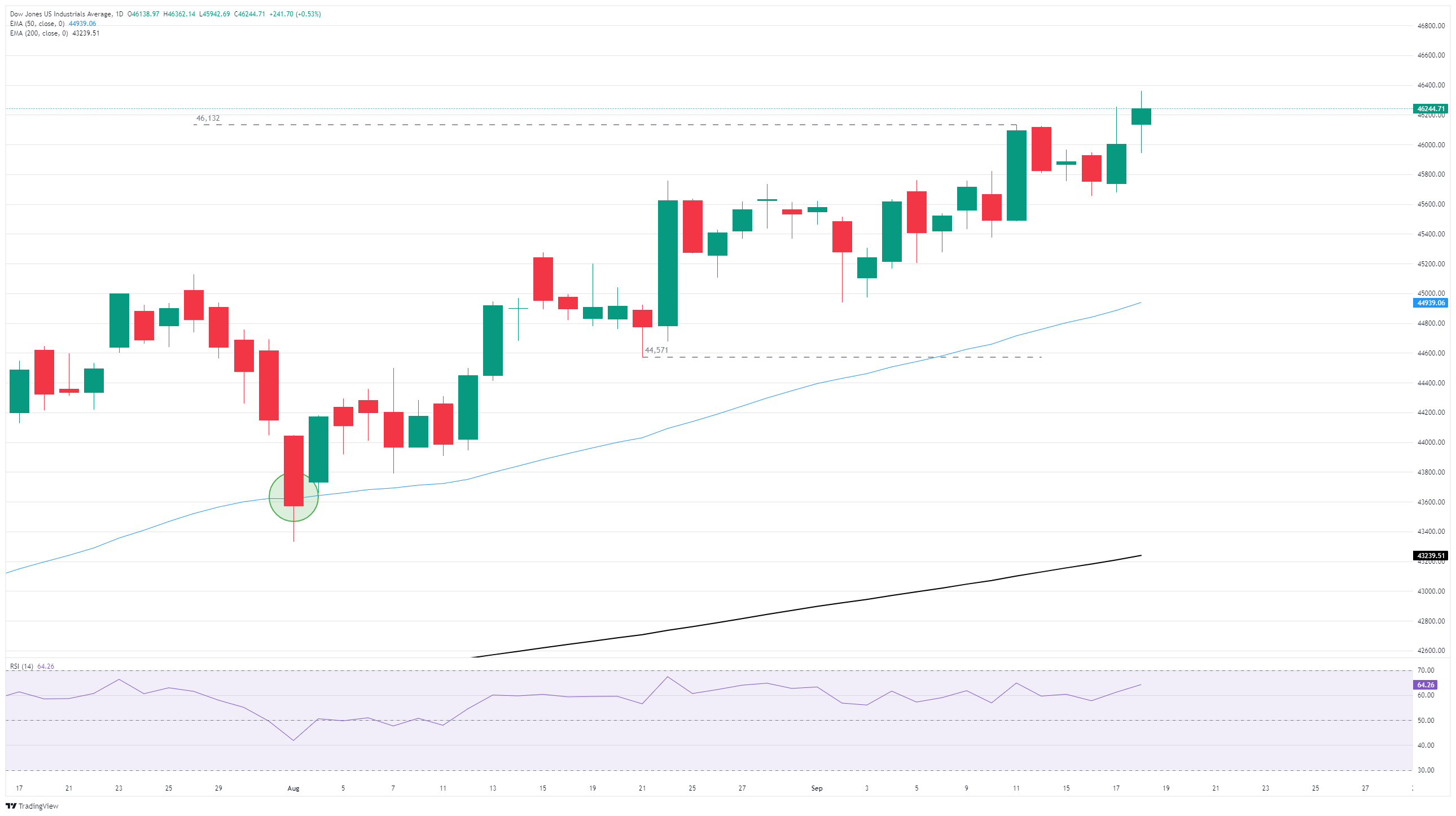
The Dow Jones clipped into the 46,200 level after a volatile start to Thursday’s trading session. The major equity index has climbed into fresh record bids following a near-term spat of congestion, but it is now up nearly eight-tenths of one percent for the week. The Dow Jones is also in the green by one-and-a-half percent for September, and on pace for a fifth straight bullish monthly close.
Rate cuts and AI investment bolster indexes
The Fed’s quarter-point rate cut this week helped to bolster market confidence that equities will continue to bleed higher despite deep cracks beginning to surface in key macro datasets, suggesting that the US economy may be on shakier footing than previously believed. Weekly Initial Jobless Claims dipped to 231K, coming in below the expected 240K, and is a welcome reprieve from the steady flow of bad news around the labor market.
Still, not all is rosy in the underlying data: despite a slight easing in the 4-week average of Initial Jobless Claims to 240K, the rolling average is still a sight higher than it was at the beginning of the year when it was sitting in the 212K to 213K range.
AI tech rally giant Nvidia (NVDA) has announced a plan to invest $5 billion in lagging tech has-been Intel (INTC). Intel stock soared around 30% on Thursday, clipping above $31.50 per share, while Nvidia added 3.75% to test $176.70 per share. The investment will give Intel, a shadow of its former chip-dominant self, a second wind to try and re-enter the AI hardware arms race. However, this is not the first time that either Invidia or Intel has attempted to brute force a late entry into an already-populated market segment with fizzling results.
According to Nvidia CEO Jensen Huang, his company’s investment into Intel represents both tech giants’ efforts to focus on new chip technology. Nvidia’s CEO stated that the investment would open up “brand new growth markets” for Intel, and would help address a $25B-$50B market.
Read more stock news: Intel stock surges over 30% after Nvidia takes $5 billion stake
Dow Jones daily chart
Nvidia FAQs
Nvidia is the leading fabless designer of graphics processing units or GPUs. These sophisticated devices allow computers to better process graphics for display interfaces by accelerating computer memory and RAM. This is especially true in the world of video games, where Nvidia graphics cards became a mainstay of the industry. Additionally, Nvidia is well-known as the creator of its CUDA API that allows developers to create software for a number of industries using its parallel computing platform. Nvidia chips are leading products in the data center, supercomputing and artificial intelligence industries. The company is also viewed as one of the inventors of the system-on-a-chip design.
Current CEO Jensen Huang founded Nvidia with Chris Malachowsky and Curtis Priem in 1993. All three founders were semiconductor engineers, who had previously worked at AMD, Sun Microsystems, IBM and Hewlett-Packard. The team set out to build more proficient GPUs than currently existed in the market and largely succeeded by late 1990s. The company was founded with $40,000 but secured $20 million in funding from Sequoia Capital venture fund early on. Nvidia went public in 1999 under the ticker NVDA. Nvidia became a leading designer of chips to the data center, PC, automotive and mobile markets through its close relationship with Taiwan Semiconductor.
In 2022, Nvidia released its ninth-generation data center GPU called the H100. This GPU is specifically designed with the needs of artificial intelligence applications in mind. For instance, OpenAI’s ChatGPT and GPT-4 large language models (LLMs) rely on the H100’s high efficiency in parallel processing to execute a high number of commands quickly. The chip is said to speed up networks by six times Nvidia’s previous A100 chip and is based on the new Hopper architecture. The H100 chip contains 80 billion transistors. Nvidia’s market cap reached $1 trillion in May 2023 largely on the promise of its H100 chip becoming the “picks and shovels” of the coming AI revolution. In June 2024, Nvidia’s market capitalization crossed the $3 trillion mark.
Long-time CEO Jense Huang has a cult following in Silicon Valley and on Wall Street due to his strict loyalty and determination to build Nvidia into one of the world’s leading companies. Nvidia neary fell apart on several occasions, but each time Huang bet everything on a new technology that turned out to be the ticket to the company’s success. Huang is seen as a visionary in Silicon Valley, and his company is at the forefront of most major breakthroughs in computer processing. Huang is known for his enthusiastic keynote addresses at annual Nvidia GTC conferences, as well as his love of black leather jackets and Denny’s, the fast food chain where the company was founded.
