
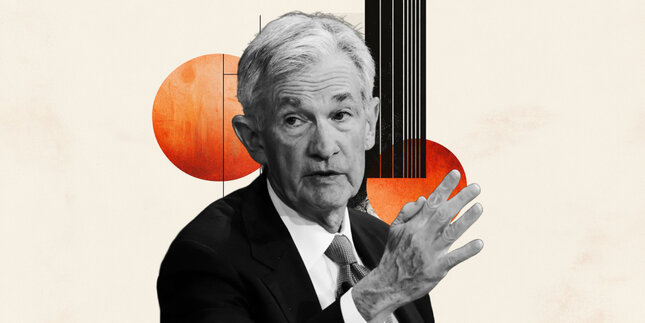

At the post-meeting press conference, Jerome Powell outlined the reasoning behind the decision to leave interest rates unchanged after the March meeting and fielded questions from reporters on the outcome.

Powell’s press conference highlights
Inflation remains elevated, in part reflecting increases in energy prices.
The current policy stance is appropriate and is promoting progress towards our goals.
Developments in the Middle East are contributing to uncertainty.
We remain attentive to risks on both sides of our mandate.
Consumer spending remains resilient.
The unemployment rate has changed little.
Slower job growth reflects slower labour force growth.
Labour demand has also softened clearly.
We see PCE inflation at 3.5% in March, with core PCE at 3.2%.
Near-term inflation expectations have risen, while longer-term expectations remain consistent with 2%.
The economic outlook remains highly uncertain.
Higher energy prices will push up inflation in the near term.
Policy is not on a preset course.
We have been working on the hypothesis that tariffs would be a one-time price effect, and expect that to play out over the next two quarters.
We are already looking through the tariff shock, but will be cautious about energy.
We will want to see the downside of energy and tariffs before even thinking about reducing rates.
The energy surge has not yet peaked.
There was a vigorous debate about guidance today.
The number of officials who would support a move away from an easing bias has increased.
The majority of the Committee did not want to change the language at this meeting.
What happens in the next 30 to 60 days could change things.
This decision was a closer call than in March.
Prospects of a rise in core inflation are real.
Policy is in a very good place to wait and see.
We are now at the high end of neutral, slightly restrictive.
We think the policy rate is in a good place.
If we need to hike, we will signal and do so.
If we need to cut, we will also signal that.
We are in a good place to move in either direction.
No one is calling for a rate hike now.
This cycle is a much closer question when it comes to changing guidance.
We are very aware that people are experiencing higher gasoline prices.
We cannot know the neutral rate with certainty.
We are closer to neutral, at the higher end of the range.
There is no case for policy looking meaningfully restrictive.
Gasoline prices will depend on how long the Strait remains closed.
It remains a question whether spending will decline to offset the inflationary effects.
This section below was published at 12:00 GMT to cover the Federal Reserve’s policy decisions and the immediate market reaction.
At its April meeting, the Federal Reserve (Fed) kept its Fed Funds Target Range (FFTR) unchanged at 3.50%–3.75%, right in line with what markets were expecting.
Highlights from the FOMC statement
The Committee decided to leave the target range for the federal funds rate unchanged at 3.50% to 3.75%.
Recent indicators suggest that economic activity has been expanding at a solid pace.
Job gains have remained low on average, and the unemployment rate has been little changed.
Inflation remains elevated, with global energy prices cited as a contributing factor.
The Committee is attentive to risks to both sides of its dual mandate.
Developments in the Middle East are contributing to a high level of uncertainty about the economic outlook.
In considering the extent and timing of additional adjustments to the policy rate, the Committee will carefully assess incoming data, the evolving outlook, and the balance of risks.
The decision was passed by a vote of 8–4. One member dissented in favour of a rate cut, while three dissented against the inclusion of an easing bias.
Bottom line
The Federal Reserve is holding steady, but the consensus is clearly fracturing. Inflation concerns, particularly linked to energy, are keeping the bar for cuts high, even as some policymakers push in that direction.
This is a Fed in wait-and-see mode but with growing internal tension — and that’s likely to keep markets on edge.
Market reaction to Fed policy announcements
The US Dollar keeps pushing higher on Wednesday, advancing for the second day in a row and approaching the 99.00 region when gauged by the US Dollar Index (DXY). The move higher in the buck also appears reinforced by a decent bounce in US Treasury yields across various maturity frames.
This section below was published at 16:30 GMT as a preview of the Federal Reserve’s policy announcements.
- The US Federal Reserve is expected to leave the policy rate unchanged for the third consecutive meeting in April.
- The economic uncertainty created by the Middle East crisis clouds the Fed’s policy outlook.
- Fed Chair Powell’s comments could ramp up USD volatility as markets see a strong chance of the bank maintaining the status quo by end-2026.
The United States (US) Federal Reserve (Fed) announces its interest rate decision on Wednesday, another pivotal meeting for markets to gauge the stance of policymakers as energy prices remain uncomfortably high amid ongoing uncertainty in the Middle East, putting the Fed’s dual mandate under strain.

Markets widely expect the Federal Open Market Committee (FOMC) to keep interest rates unchanged in the range of 3.5%-3.75% for the third consecutive meeting in April.
As this decision is fully priced in, Fed Chair Jerome Powell’s comments in his last post-meeting press conference, given his term ends in over two weeks, could offer key clues on the policy outlook and drive the US Dollar’s (USD) performance.
Republican Senator Thom Tillis, who took a stance to block any Fed Chair nominee while the probe into Jerome Powell remained open, announced that he is prepared to move on with the confirmation of Kevin Warsh after the Department of Justice dropped the investigation on Friday. Warsh is now widely expected to become the US central bank’s new chair from May 15, when Powell’s current term ends.
The CME FedWatch Tool shows that investors see little to no chance of a rate cut at least until September, while pricing in about an 80% probability that interest rates will remain where they currently are by end-2026. Earlier in the year, there were strong expectations of multiple interest rate reductions, but surging Oil prices and the potential impact on global inflation caused investors to reassess their outlooks.

The revised Summary of Economic Projections (SEP) published in March showed that policymakers’ median projection pointed to a 25 basis points (bps) cut this year, unchanged from the SEP published in December 2025. However, the minutes of the March meeting highlighted that many participants saw risk of inflation remaining elevated for longer than expected amid persistent Oil price increase, which could even call for rate hikes.
TD Securities analysts note they expect the Fed policy rate to remain unchanged in April. “The labor market remains balanced, while headline inflation has ticked up owing to the oil shock. With uncertainty still high, the Committee will likely reiterate patience. Powell is likely to stay neutral on policy and avoid new comments on succession, despite this being originally slated as his final meeting,” they explain.
When will the Fed announce its interest rate decision and how could it affect EUR/USD?
The Fed is scheduled to announce its interest rate decision and publish the monetary policy statement at 18:00 GMT. This will be followed by Fed Chair Jerome Powell’s press conference starting at 18:30 GMT.
The rate decision itself is unlikely to trigger a significant market reaction, but investors will scrutinize Fed Chair Powell’s remarks.
Powell is likely to reiterate that they need more time and data to assess whether high inflation will persist. Until now, Powell has refrained from hinting at a potential rate hike. In case he notes that option could be on the table in future meetings if the Middle East conflict prolongs and keeps Oil prices elevated, the immediate market reaction could help the USD gather strength against its rivals.
Although markets remain cautiously optimistic about a permanent truce between the US and Iran, the ongoing blockade of Iranian ports by the US military and Tehran’s reluctance to progress with negotiations until the blockade is removed don’t allow Oil prices to return to pre-war levels. The barrel of West Texas Intermediate (WTI), which was trading at around $65 before the US and Israel attacked Iran on February 28, seems to have settled above $90.
Conversely, market participants could start pricing in a September rate cut if Powell notes that the Fed will need to tilt its focus back to supporting the labor market once the situation in the Middle East is resolved. Investors could also assess Powell’s tone as being dovish if he pushes back against policy-tightening expectations and sounds optimistic about inflation quickly softening again, driven by a correction in Oil prices. In this scenario, the USD could come under selling pressure and pave the way for a bullish action in EUR/USD in the near term.
“We expect Fed Chair Powell to reiterate that the Fed’s current policy stance is appropriate, implying a high bar to resume easing. Watch out to see if Powell confirms any discussion on the next move being a hike,” BBH analysts note.
“Remember, the FOMC March meeting minutes highlighted that ‘many’ participants would favor rate increases to help bring inflation down to the 2% target in case of a lengthy war,” they further highlight.
Eren Sengezer, European Session Lead Analyst at FXStreet, provides a short-term technical outlook for EUR/USD:
“The technical outlook points to a lack of bullish momentum in the short term. EUR/USD trades slightly above the mid-line of Bollinger Bands and holds above the 100-day and the 200-day Simple Moving Averages (SMA). Additionally, the Relative Strength Index (RSI) indicator on the daily chart moves sideways slightly above 50.”
“On the upside, 1.1800 (Fibonacci 61.8% retracement of the February-April downtrend) aligns as the next resistance level before 1.1870 (upper Bollinger Band) and 1.1900-1.1910 (round level, Fibonacci 78.6% retracement). In case the pair drops below the 1.1700-1.1680 region, where the 100-day and the 200-day SMAs align, and settles there, technical sellers could show interest. In this case, the next important support level could be spotted at 1.1560 (Fibonacci 23.6% retracement) before 1.1500 (static level, round level).”

Central banks FAQs
Central Banks have a key mandate which is making sure that there is price stability in a country or region. Economies are constantly facing inflation or deflation when prices for certain goods and services are fluctuating. Constant rising prices for the same goods means inflation, constant lowered prices for the same goods means deflation. It is the task of the central bank to keep the demand in line by tweaking its policy rate. For the biggest central banks like the US Federal Reserve (Fed), the European Central Bank (ECB) or the Bank of England (BoE), the mandate is to keep inflation close to 2%.
A central bank has one important tool at its disposal to get inflation higher or lower, and that is by tweaking its benchmark policy rate, commonly known as interest rate. On pre-communicated moments, the central bank will issue a statement with its policy rate and provide additional reasoning on why it is either remaining or changing (cutting or hiking) it. Local banks will adjust their savings and lending rates accordingly, which in turn will make it either harder or easier for people to earn on their savings or for companies to take out loans and make investments in their businesses. When the central bank hikes interest rates substantially, this is called monetary tightening. When it is cutting its benchmark rate, it is called monetary easing.
A central bank is often politically independent. Members of the central bank policy board are passing through a series of panels and hearings before being appointed to a policy board seat. Each member in that board often has a certain conviction on how the central bank should control inflation and the subsequent monetary policy. Members that want a very loose monetary policy, with low rates and cheap lending, to boost the economy substantially while being content to see inflation slightly above 2%, are called ‘doves’. Members that rather want to see higher rates to reward savings and want to keep a lit on inflation at all time are called ‘hawks’ and will not rest until inflation is at or just below 2%.
Normally, there is a chairman or president who leads each meeting, needs to create a consensus between the hawks or doves and has his or her final say when it would come down to a vote split to avoid a 50-50 tie on whether the current policy should be adjusted. The chairman will deliver speeches which often can be followed live, where the current monetary stance and outlook is being communicated. A central bank will try to push forward its monetary policy without triggering violent swings in rates, equities, or its currency. All members of the central bank will channel their stance toward the markets in advance of a policy meeting event. A few days before a policy meeting takes place until the new policy has been communicated, members are forbidden to talk publicly. This is called the blackout period.
