
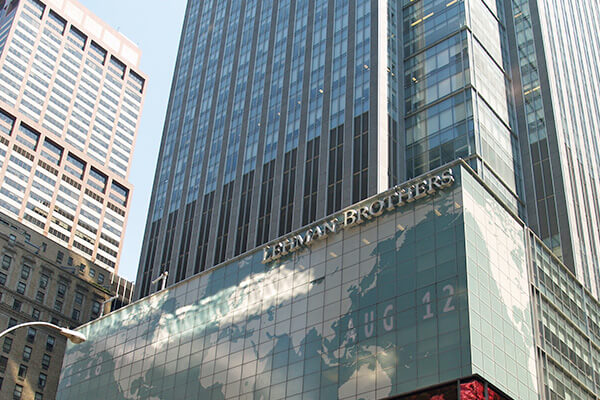
On Monday, 15th September 2008, the giant that once was Lehman Brothers filed for Chapter 11 bankruptcy. One of the US’s most established investment banks, founded in 1850, and with over 25,000 employees globally, had reached a point where its name, scale and history could no longer secure the confidence of its lenders.
The collapse raises questions that remain relevant even today. How much of your own wealth depends on another institution being able to honour its promises, and what happens if that institution cannot pay out when you need your money?
Five days from “strong” to gone
Lehman’s failure was ultimately caused by a combination of property exposure, excessive leverage, and dependence on short-term funding. It had large exposures to residential mortgages and commercial property, with heavy borrowing, much of which was short-term, and had to be continually renewed. That left the firm vulnerable on two fronts, falling property values and lenders refusing to renew funding.
Lehman’s mortgage exposure was part of a much wider problem. The mortgage securities at the centre of the wider subprime crisis depended on payments from underlying borrowers. Packaging loans into securities and assigning them credit ratings made it easier for them to sell, but it didn’t remove the risk that borrowers would stop paying. As the housing market deteriorated, investors started questioning the actual value of these securities and whether the institutions holding them could take the losses.
Before its demise, Lehman’s leverage reached roughly 30:1. At that ratio, a fall of around 3% in the value of its assets could eat up the equity supporting the business, and the borrowing would still need to be repaid.
But these numbers flattered reality. After the collapse, the bankruptcy examiner’s report found that Lehman had used a repo variant known internally as “Repo 105″ to window dress the balance sheet at the end of each quarter.
Because the assets exchanged were worth at least 105% of the cash received, Lehman treated the transactions as sales rather than borrowing, allowing them to move assets off book days before reporting results, then buy them back days later.
Around US$39 billion of liabilities were moved off the balance sheet at the end of 2007 through Repo 105 transactions, US$49 billion in Q1 2008, and another US$50 billion in Q2 2008. This practice was never disclosed to investors, rating agencies, regulators, or even the board, and whilst the leverage the market could actually see was dangerous, the underlying position was worse.
Leverage was only part of the problem. Lehman also financed assets that would take years to repay with borrowing that sometimes had to be renewed overnight. This included repurchase agreements, a form of short-term funding secured against securities. If lenders became less confident in that collateral, they could demand more protection or simply decline to renew.
A firm can own substantial assets and still lack the cash to meet immediate obligations. Selling assets quickly may require accepting below-market prices, creating further losses and giving lenders another reason to withdraw.
The deterioration was visible before Lehman’s ultimate collapse, and so were the reassurances. On 10 September 2008 Lehman pre-announced an estimated US$3.9 billion quarterly loss. On the same call, its CFO told investors that the firm’s capital position remained “strong”. That same week major rating agencies still rated Lehman as ‘A’ – investment grade.
On 15 September 2008 Lehman collapsed and filed for Chapter 11, the largest bankruptcy in US history. Five days from “strong” to gone.
Why the safeguards failed
It would be comforting to treat Lehman as a single dishonest firm that slipped through the net. But in reality it was a complete failure of almost every safeguard simultaneously.
Auditors Ernst & Young gave Lehman clean audits. In May 2008, a Lehman senior VP, Matthew Lee, wrote to his senior management warning of problems with the firm’s balance sheet. Later in June, he told Ernst & Young directly about the US$50 billion of “Repo 105″ transactions used that quarter. The day after, Ernst & Young met with Lehman’s audit committee and did not report the allegation. The bankruptcy report later found grounds for claims against the auditor, as well as Lehman’s own officers.
The regulator was also already in the building. After Bear Stearns failed earlier that year, the SEC started monitoring Lehman’s capital and liquidity on-site under a voluntary supervision programme for investment banks. Eleven days after Lehman filed for bankruptcy, the SEC closed the programme, stating ‘the last 6 months have made it abundantly clear that voluntary regulation does not work’.
And the ratings agencies, as we have seen, rated Lehman as ‘A grade’ into its final week.
The weekend a rescue failed
By the final weekend, Lehman needed a solution that could restore confidence before markets reopened. US authorities brought together the leaders of major financial institutions in an attempt to arrange a rescue. No buy-out or support package was sufficient to prevent bankruptcy.
The problem was no longer simply finding enough cash to get Lehman through another day. Emergency lending could supply cash against acceptable collateral, but it couldn’t repair a business whose capital was inadequate. In his subsequent testimony, Federal Reserve Chairman Ben Bernanke argued that Lehman needed a large cash injection and an open-ended guarantee of its obligations, support the authorities lacked the power to provide at the time.
For investors, the episode exposed the danger of relying on an assumed rescue.
How one failure spread through the system
Lehman’s failure intensified a crisis that spread through banks and credit markets globally. The danger lay in the connections between institutions. A promise that once looked dependable could become difficult, or impossible, to collect when the institution behind it ran into trouble.

Institutions facing withdrawals desperately required cash, lenders became more cautious of borrowers, and investors started questioning assets they had previously regarded as safe. Problems faced at one institution were becoming problems for everyone connected to it.
The consequences quickly reached people who had never even bought a Lehman share. On 16th September, the Reserve Primary Fund, which held over US$60 billion in assets, announced that it valued its US$785 million of Lehman debt as worthless. Its net asset value fell to 97 cents per share, “breaking the buck”.
With redemption requests exceeding US$40 billion in two days and no market willing to buy its remaining holdings at par, the fund stopped paying out and ultimately entered liquidation. A ‘low risk’ money market investment intended to preserve capital had exposed investors not only to losses, but also restrictions on access to their money.
The same evening, the US Federal Reserve bailed out AIG for US$85 billion, fearing that another major failure would cause further damage to already fragile financial markets. Lehman had been allowed to fail, but AIG was rescued the following day.
This left investors struggling to judge safety, knowing that the outcome no longer depended just on the strength of the institution, but also whether the authorities would decide to intervene.
What we learned about financial safety
What happened with Lehman exposed several distinctions that are easy to overlook when markets function normally:
- Reputation is not a substitute for financial strength. A long history, recognisable name, or large balance sheet tell savers little about the quality of an institution’s assets, or indeed how urgently it needs more funding.
- Value and access are separate questions. An investment may be expected to preserve capital, yet redemptions can still be delayed when the demand for cash rises substantially. Access is a key part of financial safety.
- Separate investments can share the same weaknesses. Distribution across institutions or products may provide less protection than expected if they still ultimately depend on similar assets, counterparties, or funding markets.
- Ownership form matters. A bank deposit is an obligation for the bank to pay a bond is an issuer’s promise to pay. An unallocated gold product generally represents a claim on a provider for metal. Each introduces a dependence on another party’s ability to uphold their end of the agreement.
What the system learnt
Lehman’s collapse led to years of litigation and a 2,200-page report. None of its top executives faced criminal charges in connection with the collapse. Ernst & Young, the auditors, settled, whilst the major ratings agencies remained part of the financial system they had failed to warn about.
The rules, at least, did change. Banks were forced to hold more capital, have stronger liquidity buffers, and undergo greater scrutiny.
But the need for intervention didn’t disappear. In March 2023, when Silicon Valley Bank and Signature Bank both failed, US authorities invoked a “systemic risk exception”, stepping in to protect all depositors, including those above the normal deposit insurance limit.
The distinction between different claims was explicit: depositors were protected, while shareholders and certain unsecured creditors were not. For uninsured depositors, protection depended on an exceptional policy decision.
The lesson is that stronger regulation can reduce the likelihood and impact of failure, but it cannot remove risk, or remove the possibility that emergency support will need to be relied on again in the future. Savers still need to understand what they own, which protections apply, and where those protections end.
Protecting the purchasing power of savings
Protecting the number on an account statement leaves a question unanswered: what will that money buy?
The years post-Lehman brought near-zero interest rates and quantitative easing. These policies sought to stabilise financial conditions whilst boosting economic activity. However, they also reduced returns on savings.
Under quantitative easing, central banks created reserves to purchase bonds in an attempt to lower longer-term interest rates and encourage spending and investment. For savers though, lower interest income made it harder for cash deposits to keep pace with rising inflation.
Consider a saver earning 1% interest whilst inflation runs at 3%. After a year, their account balance is larger, but purchasing power is roughly 2% lower. Over time, whilst appearing as modest annual shortfalls, these losses quickly compound into a substantial erosion of savings. No bank needs to fail for that loss to occur.
The post-pandemic inflation surge made the purchasing-power problem much more visible. Further monetary and fiscal support during the pandemic, disrupted production and supply chains, changing spending patterns and energy shocks all contributed to the economic conditions that followed.
For pension savers, or those trying to preserve wealth for the next generation, the concern is cumulative: whether money saved today will still buy what they need in the distant future. This becomes even harder to dismiss as public debt continues to grow past US$40 trillion, and pressures mount to keep borrowing costs manageable, leaving savers exposed to the consequences.
Gold offers a way to hold part of one’s wealth independently. Its supply cannot be expanded by a central bank decision, and ownership does not depend on a government maintaining the purchasing power of a particular currency. Its market price still fluctuates, which makes its actual performance over the period important to examine.
What gold showed over eighteen years
Gold initially fell after Lehman as investors scrambled for cash and the dollar strengthened. By March 2009, it had recovered above pre-crisis levels and went on to make strong gains through much of 2011.
There were substantial corrections along the way. But gold’s monthly average rose from US$830 in September 2008 to US$4,411 in August 2026, more than a fivefold increase in dollar terms.
Central banks continue to recognise that value. They bought more than 1,000 tonnes annually from 2022 to 2024, followed by 863 tonnes in 2025. The institutions that issue currencies are themselves accumulating a physical asset they cannot create.
What do you actually own?
Take a physically backed ETF, like GLD or IAU. Both hold gold through trust structures, while investors hold shares in the fund. Ordinary shareholders cannot redeem their shares directly for gold bars. The ETF provides convenient exposure to the gold price, but it’s not the same as owning a physical bar of gold.
Gold mining shares introduce another set of risks. Investors own part of a mining business whose performance depends on management, production costs, financing, political and operational risks, as well as the gold price. Whilst they can offer upside, they do not provide direct ownership of gold.
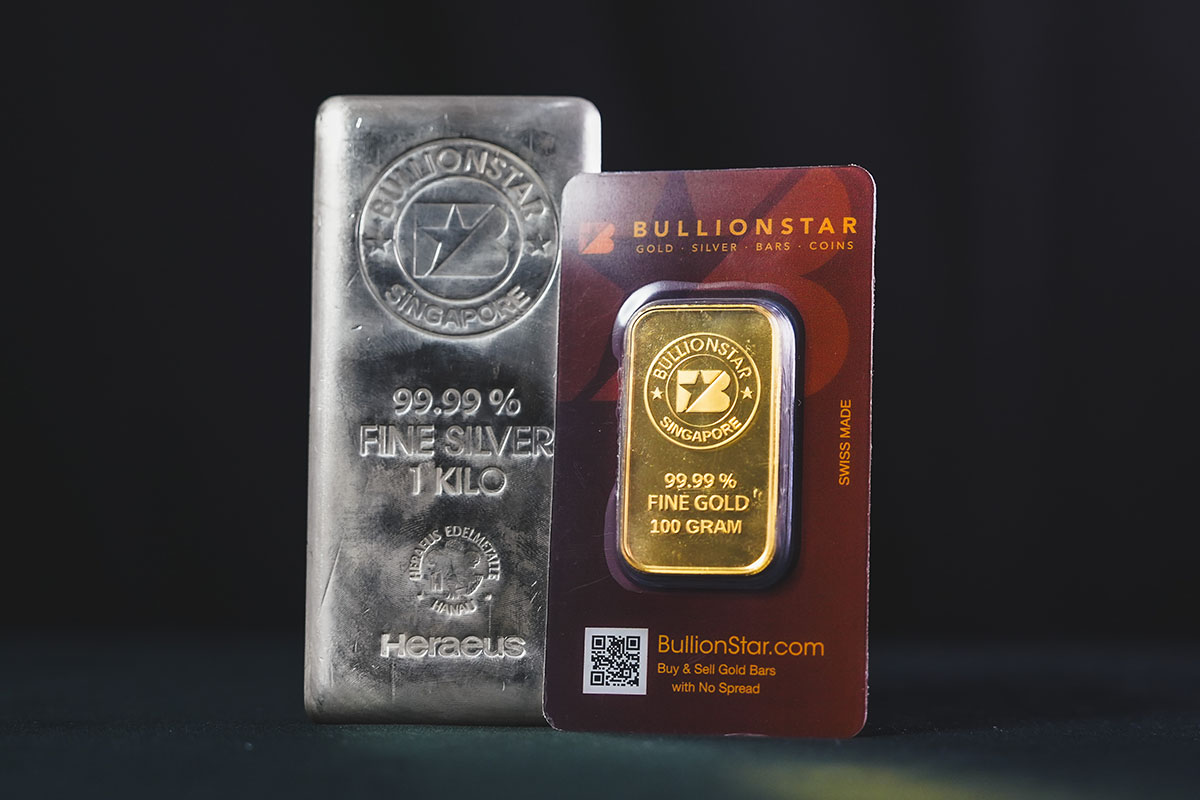
Physical bars and coins provide direct ownership. You take physical possession or use an allocated vault storage solution that holds your metal as a custodian. That is a meaningful choice, and if your objective is to reduce counterparty dependence, the legal ownership of the physical metal deserves as much attention as its price.
The lesson worth carrying forward
For savers, there are two questions to ponder: will the institution holding my money be able to repay me, and what will that money be able to buy when it does?
Physical gold provides a way to hold part of your wealth outside that chain of repayment promises. Its ownership remains clear. You do not need to predict the next banking failure to see the value in that independence. Eighteen years after Lehman, that remains a compelling reason to own physical gold.