

This guide explains the basics of buying gold bars and coins through an Australian SMSF. It covers the key things to consider when comparing your options. Read on.
If you have a Self-Managed Super Fund (SMSF) and are thinking about investing in physical gold, you may eventually come across two common options: gold bars and gold coins. At first, the choice can seem quite simple. A gold bar is a bar of gold, while a gold coin is gold made into the shape of a coin. But once you start looking at prices, purity, premiums, storage, and SMSF rules, there are a few more things worth understanding before you make a decision.
One thing you should know is that you do not need to be a gold expert to understand the difference. The main thing is to look at what you are actually buying, how much gold it contains, what you are paying for it, and whether the particular investment is suitable for your SMSF.
What Is an SMSF?
An SMSF, or Self-Managed Super Fund, is a type of superannuation fund that you control yourself. Instead of your retirement savings being managed by a large fund, you make the investment decisions as a trustee. This gives you more flexibility over where your money is invested, including assets like shares, property, and physical gold. SMSFs are regulated by the ATO, which means every investment must follow clear rules and exist solely to support your retirement.
Why SMSF Trustees Invest in Gold
Gold is all about finding equilibrium. Many Australian SMSF trustees hold gold to diversify their portfolios. Shares, property, and cash tend to move in the same direction during major market movements. Gold is sometimes very different.
And unlike paper assets, gold is tangible. It’s not dependent on a company’s performance or a promise on paper. It’s a physical asset that’s globally recognised and valued.
Is Gold an Allowable SMSF Investment?
Yes, gold is a permissible SMSF investment in Australia, but only under certain conditions. Read on for the SMSF physical bullion rules you must be aware of.
- First, your SMSF trust deed should allow for investments in precious metals.
- Second, your investment strategy should clearly mention why gold aligns with your fund’s retirement objectives and risk profile.
- Most importantly, gold needs to meet the ATO’s Sole Purpose Test. That is, it may be held only to provide retirement benefits. It cannot be used for personal purposes, displayed at home, or for any other reason.
What type of gold can an SMSF buy?
You should know that not all forms of gold are equal when it comes to SMSFs. ATO rules focus on investment-grade bullion. Usually, this would come in the form of high-purity gold bars or coins from recognised refiners or mints. These products are valued based on weight and spot price, not collectability or brand appeal.
Items that could be classified as collectible coins or jewellery often have high premiums and may pose compliance issues. For SMSFs, simplicity is usually best. Standard bullion products are easier to value, easier to audit, and easier to sell when the time arises.
ATO Rules for SMSF Gold Investment
Here are the ATO rules you must comply with for SMSF gold investment.
- All gold must be purchased in the name of the SMSF, not personally. Invoices, ownership records, and storage documents must clearly reflect this.
- Storage is an important part of the SMSF physical gold rules. SMSF gold should be stored separately from your private gold with documentation. It must be kept securely and separately, with proper documentation for audit purposes.
- Valuation is based on weight and spot price. Any product whose value is driven mainly by collectability rather than metal content can raise red flags.
ATO Requirements Regarding SMSF Gold Storage
SMSF gold storage is mandatory, and you must meet the requirements! Trustees prefer professional storage in a vault because it checks all the required ATO boxes. Gold is insured at an appropriate level, accompanied by a document, and maintained separately from the client’s own assets.
Allocated storage means that individual bars or coins are assigned to your SMSF. Pool allocation involves a common holding with audited reserves. The costs are likely to be lower.
What is essential is that the storage is safe, traceable, and audit-ready.
Gold Bars vs Gold Coins for SMSF
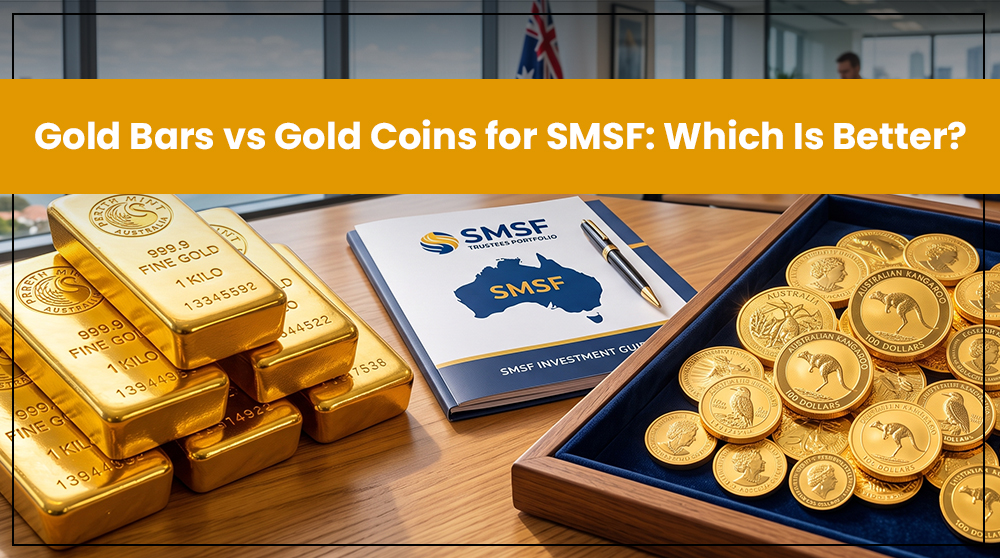
A gold bar is simply refined gold that has been made into a bar. Gold bars are available in many different sizes, from very small bars through to larger investment bars. You might come across a 1 gram bar, a 10 gram bar, a 1 oz bar, a 100 gram bar or a 1 kilogram bar, among other sizes. The larger the bar, the more gold it contains, so the overall price will be higher.
A bullion gold coin is gold that has been made into the shape of a coin. Like a gold bar, its value can be closely connected to how much gold it contains, but the price you pay may also include other costs. For example, a recognised mint has to manufacture and distribute the coin, and some coins are particularly well known among gold buyers. These factors can affect the amount you pay above the underlying value of the gold.
Please note that bullion coins and collectible coins are not the same thing. A bullion coin is generally bought mainly for its gold content, while a collectable coin may attract additional value because of its rarity, age, design or history. That difference matters when you are considering an SMSF because specific rules apply to collectables and personal-use assets.
Are Gold Bars and Coins Treated Differently Under SMSF Rules?
It can be easy to think that gold bars are always treated one way and certain coins another. But it’s not quite that simple. Whether a gold product is treated as an investment or a collectable depends on the type of product and the rules that apply to it.
The ATO has rules covering SMSF investments, including specific rules for collectables and personal-use assets. For example, the ATO explains that certain coins and other items can fall within the collectables rules depending on their characteristics and value. There are also rules around how collectables and personal-use assets can be stored and used.
This is why you should look at the particular gold product, rather than assuming that every bar or every coin will be treated in the same way.
Please note that if you are buying gold through an SMSF, your accountant, SMSF adviser or other qualified professional can help you confirm whether the particular investment meets the current requirements.
Can an SMSF Sell Gold Bars or Coins?
An SMSF can sell investments, but selling physical gold still needs to be handled as an SMSF transaction and in accordance with the applicable rules and the fund’s investment strategy.
For example, if the SMSF owns a gold bar and later decides to sell it, the transaction should be properly recorded, and the proceeds should remain part of the SMSF. The gold should not simply be taken out of the fund and treated as the member’s personal property.
Keeping proper records is important because the SMSF needs to be able to show what it owns, what it paid for its investments, and what happened when those investments were sold.
SMSF Gold Investment at Cash Your Gold
Whether you’re buying or selling physical precious metals, Cash Your Gold can help you understand your options and the value of your gold.
At Cash Your Gold, we provide SMSF trustees with clear information to help them understand physical precious metal investments. From sourcing ATO-compliant bullion through to organising secure, audit-ready SMSF gold bullion storage, everything is handled with care and total transparency. Pricing is at live market rates, documents are correctly prepared in your SMSF’s name, and storage options are designed to meet the strictest compliance requirements. There is no confusion, pressure, or stress here. Just a straightforward way of adding real, tangible assets to your retirement strategy.
How Our SMSF Gold Investment Process Works
- Step 1. Check if Your SMSF is Ready. We start by confirming that your SMSF trust deed and investment strategy allow for investment in precious metals. If updates are required, we flag them early to avoid surprises later.
- Step 2: Opening of the SMSF Account. You provide your SMSF details, including ABN, trustee details, and ID. Set up the account in your fund’s name, exactly as the ATO requires.
- Step 3: Select the Bullion. Choose from ATO-compliant bullion in gold, silver, platinum, or palladium, or select Pool Allocation if you prefer a no-fuss option without storage. We’ll help point out sizes and products commonly used by SMSF trustees.
- Step 4: Lock in Live Market Pricing. Your purchase price is fixed using live market rates at the time of confirmation. No hidden margins, no vague pricing.
- Step 5: Arrange Secure Storage. You can opt for Allocated Storage in your SMSF’s name or Pool Allocation. Both are insured, secure, and isolated from personal wealth.
- Step 6: Receive Ongoing Audit Support. We offer annual holding statements and valuation reports to enable your SMSF audit and simplify your ongoing compliance requirements.
Get in touch
Or Visit
Our Brisbane stores

North Brisbane
Chermside
Located opposite Westfield Chermside, serving Chermside and surrounding North Brisbane suburbs.
-
Address
Suite 5, 832 Gympie Rd, Chermside QLD 4032, Australia -
Phone
(07) 49 390 234 -
Email
[email protected] -
Hours
Monday to Friday: 9 am to 5 pm | Saturday: 10 am to 4 pm | Sunday: Closed

South Brisbane
Sunnybank
Located on Mains Road in Macgregor, serving Sunnybank and surrounding South Brisbane suburbs.
-
Address
Level 1, Suite 6/409 Mains Rd, Macgregor QLD 4109, Australia -
Phone
(07) 2142 6862 -
Email
[email protected] -
Hours
Monday to Friday: 9 am to 5 pm | Saturday: 10 am to 4 pm | Sunday: Closed

Logan
Browns Plains
Located in Regents Park near Browns Plains, serving Browns Plains and surrounding Logan suburbs.
-
Address
Unit 3/3376 Mount Lindesay Hwy, Regents Park QLD 4118, Australia -
Phone
(07) 2142 6482 -
Email
[email protected] -
Hours
Monday to Friday: 9 am to 5 pm | Saturday: 10 am to 4 pm | Sunday: Closed
Frequently Asked Questions (FAQs)
Q: Are gold bars or gold coins better for an SMSF?
A: Bars usually carry lower premiums per gram. Coins are easier to sell in parts. Both can be ways of owning physical gold, but you need to look at the particular product, its price, purity, premium, storage and resale, as well as whether it meets the relevant SMSF requirements.
Q: Can an SMSF invest in gold bars and gold coins?
A: An SMSF can invest in gold bullion, but the investment needs to comply with the relevant superannuation rules and the SMSF’s investment strategy. The particular product should therefore be checked before it is purchased.
Q: What type of gold can an SMSF legally invest in?
A: Investment-grade gold bullion can be held by an SMSF when the relevant rules are met. However, you should not assume that every gold item, particularly collectable items, is treated in the same way. The particular product and the circumstances of the investment matter.
Q: Are gold bars and coins treated differently under SMSF rules?
A: They can be, depending on the type of product and whether it falls within rules relating to collectables or personal-use assets. It is better to check the particular bar or coin rather than assuming that all bars and coins are treated identically.
Q: Is 999.9 gold suitable for an SMSF investment?
A: 999.9 means the gold is approximately 99.99% pure. It is a common purity for investment gold, but purity alone does not determine whether a particular product is suitable for an SMSF. The other SMSF requirements still need to be considered.
Q: Which is easier to store and insure: gold bars or gold coins?
A: There is no simple answer because it depends more on the amount of gold you own and the storage arrangement than on whether it is a bar or a coin. Both are valuable physical assets and need secure storage and appropriate insurance.
Q: Can an SMSF sell gold bars or coins at any time?
A: An SMSF can sell investments, but the sale still needs to be handled properly and in line with the fund’s investment strategy and applicable rules. The proceeds from the sale remain part of the SMSF.
Q: What should I consider before buying gold for my SMSF?
A: Look at the product’s purity, weight, price and premium, and check who made or minted it. You should also consider storage, insurance, documentation, resale and whether the investment fits your SMSF’s investment strategy and the current superannuation rules.
