
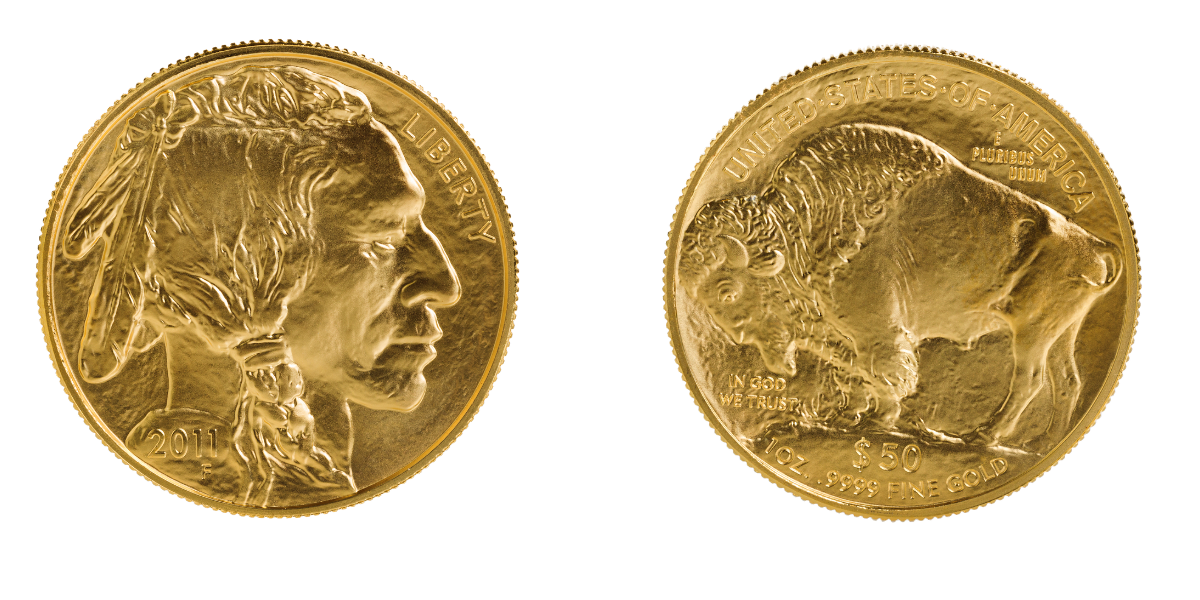

American Buffalo coins are among the most recognizable coins in the United States. With their bold Native American profile on one side and American bison on the other, they carry a design that has been admired by collectors for more than a century. Today, the modern American Buffalo Gold Coin is also highly valued because it contains one full troy ounce of 24-karat gold.

That value and popularity have also made American Buffalo coins a target for counterfeiters. In recent years, collectors, investors, and coin dealers have seen more fake coins appear through online marketplaces, social media listings, private sales, and walk-in transactions. The FBI and U.S. Department of the Treasury have warned that counterfeit coins are being sold online to both investors and collectors, including bullion and high-value collectible coins.
Whether you inherited a coin, bought one online, or are considering selling one, it is important to know what the American Buffalo coin is, where its design came from, and what warning signs may point to a counterfeit.
What Is the American Buffalo Gold Coin?
When most people talk about an “American Buffalo coin” today, they are usually referring to the American Buffalo Gold Coin. The United States Mint launched the American Buffalo Coin Program in 2006, and the one-ounce coin became the first 24-karat gold proof coin ever struck by the U.S. Mint. Its design is based on the 1913 Type I Buffalo nickel created by sculptor James Earle Fraser.
The modern American Buffalo Gold Coin is a $50 legal tender gold coin containing one troy ounce of .9999 fine, 24-karat gold. According to the U.S. Mint, the American Buffalo Gold Bullion Coin’s content and purity are guaranteed by the U.S. government.
The History Behind the American Buffalo Design
Although the modern gold coin began in 2006, its design is much older. The original Buffalo nickel was produced by the U.S. Mint from 1913 to 1938. Designed by James Earle Fraser, the coin featured the profile of a Native American on the obverse and an American bison on the reverse.
The design quickly became one of the most iconic in American coinage. The U.S. Mint notes that Chief Iron Tail, Chief Big Tree, and Chief Two Moons modeled for Fraser, and that the buffalo model came from the Central Park Zoo.
The American Buffalo design returned in 2001 on a commemorative silver dollar honoring the National Museum of the American Indian. A few years later, the design was used again for the American Buffalo Gold Coin, bringing Fraser’s classic imagery to one of the purest gold coins produced by the United States Mint.
Why American Buffalo Coins Are So Popular
American Buffalo Gold Coins appeal to both collectors and precious-metal investors.
For investors, the appeal is straightforward: the coin contains one troy ounce of .9999 fine gold. For collectors, the appeal goes beyond gold content. The coin carries one of the most admired designs in U.S. coin history, giving it both bullion value and collectible interest.
There are also different versions of the coin. Proof American Buffalo coins are collector versions sold by the U.S. Mint, often presented in official packaging with a Certificate of Authenticity. Bullion versions are investment-focused and are distributed through the U.S. Mint’s authorized purchaser network. The proof coin’s collector packaging can add appeal, but it should never be treated as the only proof of authenticity because packaging and paperwork can also be copied.
Why Counterfeit American Buffalo Coins Are a Serious Concern
Counterfeiters have become increasingly creative. Some fake coins are obvious, with poor details, strange coloring, or incorrect measurements. Others are more deceptive and may look convincing to someone who does not handle gold coins regularly. NGC, one of the major third-party coin grading services, notes that counterfeiters use a wide variety of methods, ranging from crude casts to more deceptive forgeries and alterations.
The risk is especially high when buying from unknown online sellers. The FBI recommends purchasing from reputable, registered coin dealers and having coins tested by a certified organization when buying outside trusted channels.
How to Tell If an American Buffalo Coin Is Authentic
No single at-home test can guarantee that an American Buffalo coin is real. However, there are several red flags that can help you identify when a coin needs professional inspection.
1. Check the weight and diameter
A genuine one-ounce American Buffalo Gold Coin should match the U.S. Mint’s published specifications. The gold fine weight should be 1.0000 troy ounce, and the diameter should be 1.287 inches, or 32.70 mm. The edge should be reeded.
2. Compare the design to official examples
The obverse of the American Buffalo Gold Coin features Fraser’s Native American profile. The reverse shows an American buffalo, also known as a bison. The reverse inscriptions include “UNITED STATES OF AMERICA,” “E PLURIBUS UNUM,” “IN GOD WE TRUST,” “$50,” “1 OZ.,” and “.9999 FINE GOLD.”
Counterfeit coins may have lettering that looks too thick, too thin, uneven, poorly spaced, or soft around the edges. The bison’s body, the Native American profile, and the field around the design should also be examined closely.
3. Look at the surface quality
A genuine struck gold coin should have crisp details and a consistent finish. Counterfeits may show signs that something is wrong, including:
- grainy or porous surfaces
- weak or mushy details
- raised lumps or pits
- unnatural shine
- incorrect color
- plating bubbles
- tool marks
- unusual wear for a supposedly new coin
NGC notes that cast counterfeits often have a grainy texture and may lack the normal “ring” of a struck coin. Cast fakes may also show a seam around the edge where the mold halves came together.
4. Inspect the edge
The edge of a coin can reveal problems that are harder to see from the front or back. A genuine American Buffalo Gold Coin has a reeded edge. Watch for uneven reeds, flat spots, filing marks, seams, or areas that look repaired.
A seam around the edge is a major warning sign. While not all counterfeits are cast, edge problems are common enough that they should never be ignored.
5. Be cautious with packaging and certificates
Official U.S. Mint packaging and a Certificate of Authenticity can support a coin’s history, especially for proof versions. However, packaging alone does not prove a coin is genuine. Counterfeiters can copy boxes, capsules, certificates, and labels, or they may pair fake coins with genuine-looking materials.
The coin itself should still be examined.
6. Be wary of deals that seem too good to be true
American Buffalo Gold Coins contain one ounce of gold, so their value is closely tied to the current price of gold. A seller offering one far below the market value of its gold content should raise immediate concern.
Scammers often use pressure tactics, vague stories, or unusually low prices to push buyers into quick decisions. Before buying, research the seller, check reviews, verify business information, and avoid transactions where the seller refuses testing or professional review.
7. Get professional testing
The most reliable way to authenticate a high-value gold coin is to have it inspected by a qualified professional. Dealers and grading services may use tools such as precision scales, calipers, magnification, density testing, and metal analysis.
For a coin as valuable as an American Buffalo Gold Coin, professional authentication is worth the extra step.
