

Let me start with a statement that may change the way you look at trading:
Where you place your stop is more important than where you enter a trade.
Understand this concept and your approach to finding trades may change. Instead of starting with an entry and then deciding how much you are willing to lose, start by identifying where your trading idea would stop making sense. The entyry level for your trade then follows.
This means looking at stops as more than a necessary evil. A well-placed stop helps define the trade, determine its size, and establish whether the opportunity is worth taking.
The goal is straightforward: give your position room to work while knowing in advance what would tell you it is time to get out.
Look at Support and Resistance Differently
We all know about support and resistance. Most traders look at these levels as places to buy or sell against. But there is another way to look at them.
An obvious support or resistance level can also be an obvious place for stops to accumulate.
A trader buys above support and places a stop just below it. Another sells beneath resistance and places a stop just above it. When many traders follow the same approach, orders can cluster around those areas.
A move through the level may trigger stops and accelerate the price move. Sometimes the market continues. At other times, it reverses after those orders have been absorbed.
That second outcome is particularly frustrating. You had the right directional idea, but your stop took you out before the trade had a chance to work.
Markets do not move solely to hunt stops, even though it might seem that way and every break of support or resistance is not evidence of manipulation. Nevertheless, recognizing where stops may be concentrated can help you judge whether your own stop is sitting in an especially vulnerable location.
Place Your Stop Where the Trading Idea Changes
Your goal should be to find a stop that allows you to stay in a position while the reason for taking it remains valid. That does not mean finding a stop that can never be hit. There is no such level. It means asking a better question:
What would the market have to do to tell me this trade is no longer working as intended?
That is different from asking: “How many points or pips (or points) am I willing to lose?”
Your financial risk matters. But the amount you are comfortable losing should help determine your position size, rather than force your stop into a location that has little connection to the market structure.
A stop chosen simply because it is close may offer a small potential loss. It may also sit inside ordinary price movement, where the market can reach it without changing the broader technical picture.
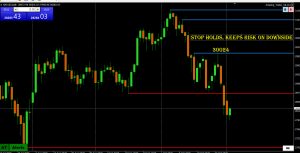
NAS100 DAILY CHART (CFD):
Move above 30024 would have told you a short position was wrong but the level (nd stop) held and did noit change the technical picture
 .
Identify Game-Changing Levels
I call the important reference points game-changing levels.
These are areas where a break would materially change the technical picture supporting your trade.
For a long position, that might be a significant low whose failure would undermine the bullish setup. For a short position, it might be a high whose break would weaken the bearish case.
The distinction is important. Not every nearby high or low changes the outlook. Some are minor reference points within a larger move.
Before entering, ask:
- What is the reason for taking this trade?
- Which level supports that reasoning?
- Would a break of that level change the picture?
- Is my stop allowing for normal volatility around the area?
No stop placement can perfectly distinguish a temporary break from a lasting one. The purpose is to make the exit deliberate and connected to your trading idea.
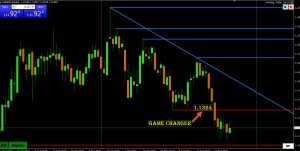
EURUSD Weekly Chart: Break of 1.1324 was a game changer
Embrace the Retrace: How to Turn Market Pullbacks Into Trading Opportunities
Build the Trade Around the Stop
Here is how this approach can turn the usual trading process around.
1. Be Aware of the Longer-Term Trend
Start with the broader picture, even if you plan to trade a shorter time frame.
Are you trading with the prevailing direction or attempting a move against it? That context can help you assess the setup and keep your expectations realistic.
Tip: If trading against a prevailing trend (e.g. a correction), look to take porifts sooner rather than holding out for the last pips as prices will more often than not turn quicker once the move runs out of steam.
2. Pick the Side You Want to Trade
Identify whether you want to look for buying or selling opportunities.
The objective is to recognize which side appears to have the advantage. Finding a suitable entry comes after deciding what you are trying to trade.
Tip: Choosing the “strong side” (i.e. the side less likely to get stopped out) is more than half the battle in putting on successful trades.
3. Find the Game-Changing Stop Level
Identify the area that would undermine the setup if broken.
Do this before becoming attached to an entry price. Otherwise, it is easy to choose an attractive entry first and then invent a reason for placing the stop nearby.
4. Assess the Entry and Potential Reward
Once you know where the stop belongs, evaluate the entry.
The entry still matters. as it affects the distance to your stop and the potential reward relative to the risk.
If the available entry leaves too much risk for too little potential reward, pass on the trade. A sensible stop does not automatically make every entry worthwhile.
Adjust Position Size to Match the Stop
A wider stop does not have to mean taking a larger financial risk.
Adjust the size of the position to match the distance to the stop.
For example, in a USD-denominated account trading GBPUSD:
| Position size | Stop distance | Approximate planned risk |
|---|---|---|
| 100,000 GBPUSD | 10 pips | $100 |
| 50,000 GBPUSD | 20 pips | $100 |
The second position has twice the stop distance but half the trade size. The planned dollar risk is the same before trading costs and any slippage.
This gives you the flexibility to choose a stop based on the setup while keeping the amount of your capital at risk consistent.
If the required position size or potential loss does not suit your account, skip the trade. Do not force the stop closer simply to make the numbers look better.
Decide Before Entering, Not After the Trade Moves Against You
There is an important difference between planning a wider stop before entering and moving a stop farther away after a position starts losing.
The first is part of building the trade. The second increases the risk you originally accepted.
Identify the level, calculate the position size, and decide whether you are comfortable with the potential loss before placing the trade.
Remember, a stop order does not guarantee execution at the exact stop price. Fast markets and gaps can produce a larger loss than planned.
Change the Question You Ask Before Every Trade
I used to spend more time trying to fine-tune my entry. Sometimes I missed trades while waiting for a slightly better price.
Now, my first concern is where the stop belongs.
That does not make the entry unimportant. It changes the order of the decisions.
Instead of asking, “Where can I get in?” start with:
“Where would this trading idea stop making sense?”
Find that level. Assess the entry and potential reward. Adjust your position size. Then decide whether the trade is worth taking.
You cannot control whether the next trade wins. You can control how you structure it and how much risk you accept.
That is where confidence should begin.
Suggested SEO Title: Stop-Loss Placement: Why Your Stop Matters More Than Your Entry
Meta Title: Stop-Loss Placement: Why Your Stop Comes First
Meta Description: Rethink stop-loss placement. Learn how to identify game-changing levels, avoid obvious stop locations, and adjust position size to control trading risk.
Focus Keyword: stop-loss placement
URL Slug: stop-loss-placement-before-entry
WordPress Tags: Stop-Loss Placement, Trading Risk Management, Support and Resistance, Position Sizing, Trading Psychology, Forex Trading, Trading Strategy
The post Stop-Loss Placement: Why Your Stop Matters More Than Your Entry appeared first on Forex Trading Forum.
