

A market falls sharply. You buy what looks like a bargain. Prices bounce briefly, then selling resumes and another low appears. This is where knowing how to trade a liquidating market pays off.
You try again, convinced the market has fallen far enough. The result is the same.
Welcome to a liquidating market, where the urgency to exit positions can overwhelm attempts to pick a turning point.
Understanding how to trade a liquidating market starts with recognizing the environment. Before looking for an entry, ask a more basic question: Are traders building positions, or are they rushing to get out?
That distinction can change how you interpret every bounce, pause and break of support.
What Is a Liquidating Market?
A liquidating market is a phase in which the unwinding of existing positions becomes a major driver of price movement.
During long liquidation, traders sell positions they previously bought. Some take profits, others cut losses, and some may be forced to reduce exposure because of margin requirements or risk limits.
The result can be a sharp decline in which rallies struggle to develop and support levels offer little resistance to the selling.
Liquidation can also work in the opposite direction. Traders exiting short positions must buy them back. When that buying becomes urgent, it can produce a short squeeze with repeated pushes higher and only shallow pullbacks.
The common feature is the urgency to exit.
There is still a buyer for every seller. What changes is which side is more aggressive and how far prices must move to attract enough opposing interest.
A chart alone cannot prove that liquidation is driving a move. However, the pattern of failed corrections and repeated extensions can provide useful clues.
How to Identify a Liquidating Market
The same move can look very different depending on the timeframe.
A higher timeframe shows the overall pressure. A lower timeframe reveals the pauses and failed recoveries within it.
Higher Timeframes Show the Dominant Direction
On a four-hour chart, long liquidation may look like an almost uninterrupted decline.
Candles overlap less, recoveries remain limited, and previously important support levels may break with little hesitation.
The impression is a one-way street.
That does not mean every candle closes lower. It means attempts to reverse the move are failing to produce meaningful follow-through.
Four-hour NAS100 chart showing a sustained decline on a higher timeframe (Nov 6, 2026)

Lower Timeframes Reveal the Failed Bounces
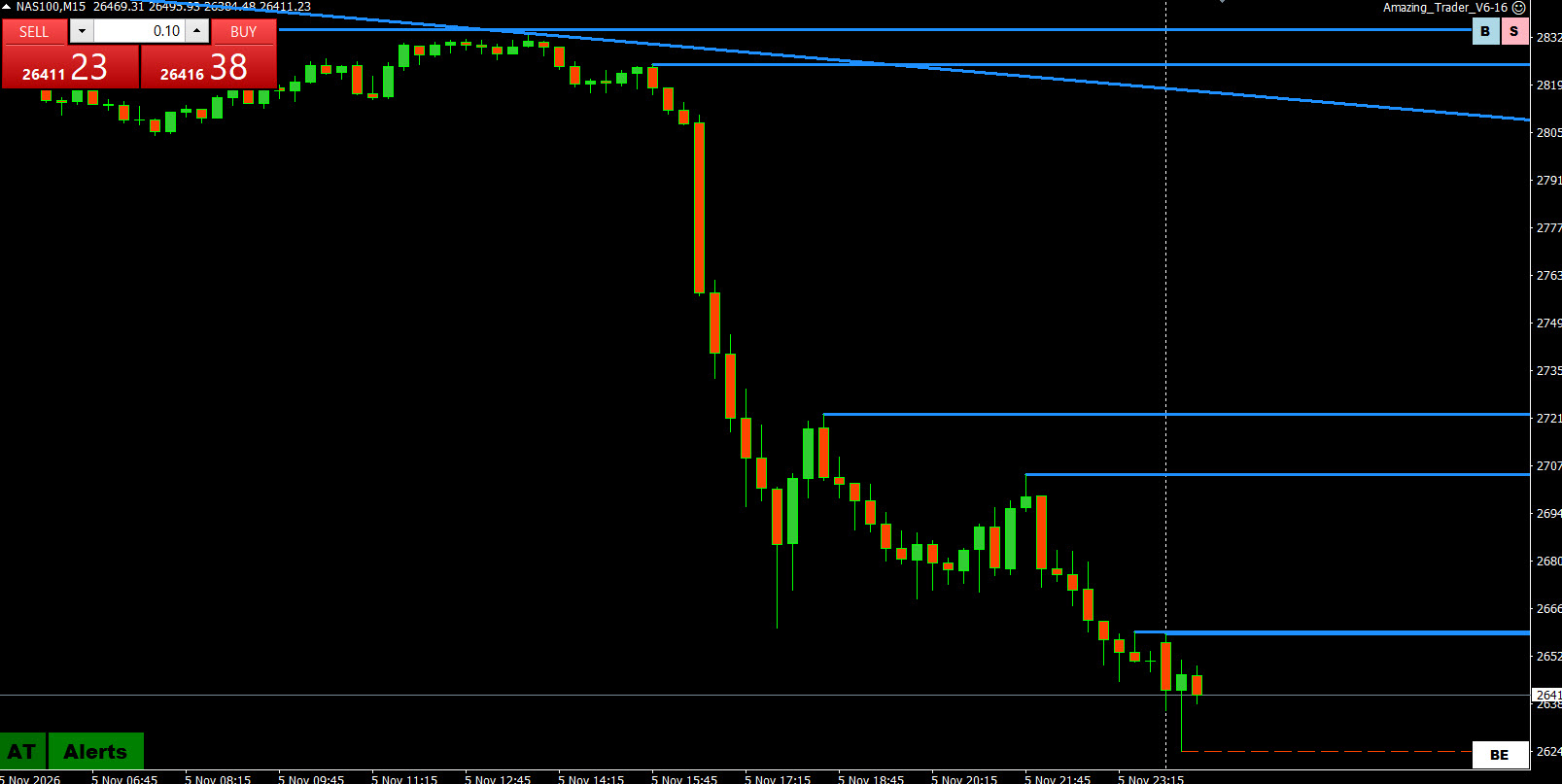
Move down to a 15-minute chart and the same decline becomes a series of episodes:
- A sharp drop.
- A brief pause.
- A small recovery.
- A failure to extend that recovery.
- Another push to fresh lows.
These pauses can tempt bottom-pickers. After several large declines, even a modest bounce may look like the beginning of a reversal.
But a pause in selling is not the same as a change in control.
The useful question is whether buyers can build on the bounce before sellers regain the upper hand.
NAS100 15-minute chart highlighting pauses, failed bounces and fresh lows. (Nov 6, 2026)
US500 15-minute chart showing a failed bounce and subsequent new low. (Nov 6, 2026)

Why Liquidation Moves in Waves
Liquidating markets often move in spurts rather than at a steady pace. Several forces can contribute to that pattern.
Large Positions May Be Unwound in Stages
Large traders do not always exit an entire position in one transaction. Orders may be divided into smaller pieces and executed over time.
When one wave of selling is absorbed, the market may stabilize. Another round of exit orders can then restart the decline.
The brief recovery does not necessarily mean the selling is finished.
Early Bottom-Pickers Can Become the Next Sellers
A falling market attracts traders who believe prices have become too cheap.
Their buying may support a temporary bounce. If that bounce fails, some will exit voluntarily, while others will have protective stops triggered.
Those exits can add selling pressure to an already weak market.
Broken Support Can Accelerate the Move
Widely watched technical levels can act like tripwires.
When support breaks, protective sell stops may activate and momentum traders may enter new short positions. These flows can combine with existing liquidation to produce another rapid decline.
That is why a market can appear to settle down, then suddenly accelerate again.
How to Trade a Liquidating Market
Recognizing the environment does not automatically create a trade.
You still need an entry, a point that invalidates the idea and enough potential reward to justify the risk.
There are three approaches to consider.
-
Trade a Failed Pullback With the Prevailing Flow
During long liquidation, a brief rally may provide an opportunity to sell in the direction of the dominant pressure.
The key is to look for evidence that the recovery is failing rather than assuming every uptick should be sold.
For example, the market may rebound, stall below a previous breakdown level and then begin turning lower again.
The high of that recovery can become a reference point for assessing whether the setup remains valid.
However, placing a stop just above a pause high does not automatically make the trade attractive. The level must fit the market structure, and the position size must reflect the distance to the stop and prevailing volatility.
If there is no sensible place to define risk, there may be no sensible trade.
The same logic applies in reverse during a short squeeze: a pullback that fails to extend lower may offer an opportunity to join the buying pressure.
-
Use a Stop Entry to Join a Potential Continuation
Another approach is to wait for the market to break out of a pause.
During long liquidation, a trader might consider a sell-stop entry below the low of a consolidation. During a short squeeze, the equivalent would be a buy-stop entry above its high.
The purpose is to require renewed movement in the expected direction before entering.
However, a stop entry is not automatically more effective than entering on a pullback. A break can fail, and an entry near the end of an extended move can leave little room before a reversal.
Execution also matters. A stop order that becomes a market order may fill beyond its trigger price in a fast market. A stop-limit order provides price control but may remain unfilled.
Before placing the order, identify:
- What would invalidate the trade.
- Where the protective exit belongs.
- Whether the remaining opportunity justifies the risk.
- How slippage could affect the position.
A new low can signal continuation. It can also be the final push before a rebound. The surrounding price action matters.
Stop-Loss Placement: Why Your Stop Matters More Than Your Entry
-
Wait for a Change in Behavior Before Trading Against the Move
Trying to pick a bottom during liquidation means buying while other participants are still urgently selling.
Being early can be expensive, especially when repeated attempts produce a string of small losses.
Instead of asking whether the market has fallen enough, look for evidence that its behavior is changing.
Possible clues include:
- A fresh low that fails to attract sustained selling.
- A recovery above a recently broken level.
- A pullback that holds above the latest low.
- Buyers extending a rebound beyond previous pause highs.
- Stabilization that remains visible when you step up a timeframe.
You cannot confirm from candles alone that sell stops have “dried up.” What you can observe is whether breaks lower continue to produce follow-through.
A failure to extend the decline is more useful than the feeling that prices are cheap.
Even then, the first recovery may be temporary. Evidence of stabilization supports a trading decision; it does not guarantee a lasting bottom.
The Biggest Mistake: Repeatedly Betting on a Reversal
The most damaging mistake is often a sequence of trades built around the same hope.
The pattern becomes familiar:
- You buy because the market looks oversold.
- A small bounce encourages you.
- Selling resumes.
- Your stop is hit.
- Another low appears.
- You buy again, expecting this attempt to be different.
Each trade may seem manageable on its own. Together, they can damage both your account and your judgment.
By the time a stronger reversal develops, you may be emotionally worn down or reluctant to act.
An oversold reading can describe how far or how quickly a market has fallen. It does not tell you when liquidation will end.
Hope is not evidence that control has changed.
Manage Risk Before Looking for the Next Wave
Fast movement can make an opportunity appear more attractive while making execution more difficult.
When you trade a liquidating market, consider whether wider swings require a smaller position. Avoid forcing a tight stop into a market that is moving well beyond its recent trading ranges.
Also, watch your cumulative exposure. Short positions in several closely related equity indices can amount to multiple versions of the same trade.
After repeated failed entries, reassess the setup rather than assuming another attempt is justified. The market may have changed, or the available opportunity may no longer compensate for the risk.
Sometimes the clearest decision is to remain on the sidelines.
You do not need to participate in every liquidation wave.
Recognize the Environment Before You Trade a Liquidating Market
The hardest trade is often the one that feels least comfortable.
Buying after a sharp decline can feel easier because the price looks attractive. Selling a failed bounce may feel harder because the market has already fallen so far.
Neither feeling determines whether the trade is sound.
What matters is the prevailing pressure, the market’s response to corrections and your ability to define risk.
During long liquidation, repeated failed rallies suggest sellers still have the upper hand. During a short squeeze, repeated failed pullbacks suggest buyers remain in control.
Identify the strong side first. Then decide whether there is an entry worth taking.
When the behavior changes, reassess. Until then, a pause is a pause, a bounce is a bounce, and neither becomes a reversal simply because you want it to.
The post When Every Pullback Fails: How to Trade a Liquidating Market appeared first on Forex Trading Forum.
