

Theory of Inevitability in Trading
Why does a market repeatedly approach an obvious high or low, back away, and then return to test it?
The Theory of Inevitability in trading, developed by the Global-View founders, offers a way to interpret this behavior. Its central premise is that markets, given the opportunity, will almost always attempt to reach a significant price level to see what lies there.
That level might contain stop-loss orders, breakout entries, strong buying or selling interest, or a combination of all three.
The theory helps traders identify which side of the market is most vulnerable and which price levels are likely to attract a test. It does not predict what will happen after the market gets there.
Anticipating the test and anticipating the outcome are two different trading decisions.
Theory of Inevitability in Trading
What Is the Theory of Inevitability in Trading?
The Theory of Inevitability describes the tendency for price to probe an important level when market conditions allow it.
Imagine a currency pair trading just below a well-established high. Sellers have defended that high twice, but each pullback is becoming smaller. Buyers continue to return, leaving price within striking distance of resistance.
Under the theory, the question becomes: If sellers cannot push the market away, how long before buyers attempt to find out what sits above that high?
Buy stops from traders holding short positions may be waiting there. So may orders from traders looking to enter on a breakout. Together, those orders can add buying pressure if the level is breached.
However, a test could also encounter enough selling to absorb that demand and send price lower.
The destination may look increasingly likely. The reaction remains uncertain.
Why Do Key Price Levels Attract Attention?
A widely watched chart level brings together traders with different positions, expectations, and orders.
Around a prominent high, for example:
- Existing sellers may place protective buy stops above resistance.
- Breakout traders may place buy orders above the same area.
- Other sellers may wait for higher prices before entering.
- Traders holding long positions may use the test to take profits.
This concentration of interest helps explain why price can accelerate, stall, or reverse around an obvious level.
Common Levels to Watch
Potential targets include:
- Previous daily, weekly, or monthly highs and lows.
- Prominent highs and lows on four-hour and daily charts.
- Double tops and double bottoms.
- The boundaries of an established trading range.
- Psychological round numbers, such as EURUSD 1.1000, USDJPY 160.00, XAUUSD 4000 or NAS100 30000.
- Intraday “50” levels, such as EURUSD 1.1050 or XAUUSD 3850.
The Power of 50: How Round Numbers Shape Trading Sentiment
A level becomes more relevant when price behavior suggests that the side defending it is losing control.
An obvious level alone is not enough. The market must have an opportunity to reach it.
What Does “Given the Opportunity” Mean?
This qualification is central to the theory.
A previous high does not become an immediate target simply because it exists. Price may be moving away from it, facing intervening resistance, or responding to a fresh catalyst that changes the direction of trading.
An opportunity becomes more apparent when:
- Price remains close to the target.
- Attempts to move away repeatedly fail.
- Pullbacks become shallower.
- Momentum points toward the level.
- There are few meaningful obstacles between price and the target.
For example, repeated failures to rally away from support can leave buyers vulnerable. If each bounce ends at a lower high, sellers may be gaining the opportunity to test the low again.
The practical question is: Which side is having more difficulty moving the market away from danger?
Why the Theory Is Useful in Forex
Forex provides many opportunities to apply this framework because traders closely monitor major currency pairs, prominent chart levels, and round numbers.
The forex market does not have a single universal spot-price feed. It is a decentralized, over-the-counter market, with trading spread across dealers and venues. Prices and individual candle highs or lows can differ between platforms because of different rate feeds and bid/ask spreads. Still, they are close enough that anyone looking at a similar time frame chart will see similar levels, give or take a few pips.
The useful point is that traders can still identify broadly similar areas of interest without seeing identical prices.
For execution, traders should use the levels and order-trigger rules relevant to their own platform. This also matters when applying the theory to gold, stock indices, cryptocurrencies, or other instruments offered through different brokers.
Do Algorithms Hunt Stops?
Stop hunting is a familiar trading description for moves through areas where protective orders are thought to cluster.
Algos can respond to price, momentum, and available order-flow information. But a chart cannot establish that a particular move was deliberately engineered to trigger stops, and no participant has a complete view of every stop order across the forex (or another) market.
The theory does not require proof of deliberate stop hunting. Its practical value comes from recognizing where orders may concentrate and observing how price behaves as it approaches those areas.
Currency Options Defense: Why Some Price Levels Keep Holding and Others Break
How to Apply the Theory of Inevitability
Step 1: Identify the Vulnerable Side
Start by examining who is failing to follow through.
Are sellers unable to produce a meaningful decline from resistance? Are buyers unable to sustain a bounce from support?
Repeated failures can reveal which side is struggling before the key level breaks.
Step 2: Mark the Target and Intervening Levels
Identify the high, low, range boundary, or round number that could attract a test.
Then check what stands in the way. A nearby target with limited resistance along the path presents a different situation from a distant target separated by several major obstacles.
Step 3: Watch How Price Approaches
A strong advance followed by shallow pullbacks may increase attention on resistance. Lower highs pressing toward a common floor may increase attention on support.
Repeated tests matter, but there is no dependable rule that the third test must break. The quality of the approach matters more than the number of touches.
Step 4: Separate the Test From the Trade
A likely test can help frame a potential target for an existing position. It does not automatically justify a new entry.
Before entering, traders still need a defined setup, an invalidation point, and sufficient potential reward relative to risk.
Step 5: Assess the Reaction
Once the level is reached, look for evidence of continuation or failure.
A breakout that holds beyond the level and survives a retest presents a different picture from a brief breach followed by a sharp return into the previous range.
Reaching the target completes one part of the analysis. The reaction begins the next.
Trading Example: A Test of EURUSD 1.1000
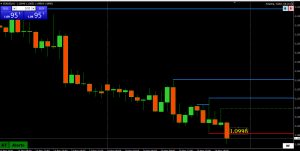
Consider this real-time setup on the EURUSD weekly chart. The longer-term trend is down.
- The break of 1.1324, the bottom of a consolidation range and the 2026 low, pointed to the next support at 1.1065.
- The Theory of Inevitability says that as long as EURUSD trades below 1.1324, the market will, given the opportunity, make a run at 1.1065. On a weekly chart, nobody said it would be a smooth ride.
- Once 1.1065 was solidly broken, the theory says the market will make a run at 1.1000 to see what lies there.
- After repeared tests, 1.10 has been broken.
This theory does not predict the outcome, only the risk.as it helps identify a destination. The approach and reaction help determine what comes next.
What Happens After Stops Are Triggered?
A stop run can produce different outcomes.
Breakout and Continuation
Triggered stops and fresh entries may reinforce the move. If demand or supply continues beyond the initial burst of orders, price can extend further.
Failed Breakout and Reversal
Price may briefly cross a level but attract little follow-through. A return into the previous range can leave breakout traders vulnerable and create pressure in the opposite direction.
Consolidation
After the initial orders are absorbed, neither side may retain enough control to extend the move. Price can settle into a range.
Clearing stops does not automatically produce a reversal. The next move depends on the balance of buying and selling that remains.
Using the Theory for Targets and Risk Management
The theory can help traders set realistic targets by identifying areas the market appears increasingly likely to probe.
It also encourages a closer look at stop placement. An obvious high or low may be a sensible reference point, but placing a stop immediately beyond it can expose a position to a brief test.
That does not mean stops should simply be widened. Stop placement should reflect where the trade idea becomes invalid, with position size adjusted to keep risk within the planned limit.
The same thinking can discourage chasing. If price has already traveled most of the distance toward its target, the remaining opportunity may offer poor risk/reward.
The Limits of the Theory of Inevitability
Despite its name, the theory is an observational trading framework, not a guarantee.
A target can remain untouched. Momentum can fade. News can change the direction of trading. A seemingly vulnerable level can attract enough opposing interest to repel the move.
The framework is most useful when it keeps traders focused on three questions:
- Which side is most vulnerable?
- Which level is the market being given an opportunity to test?
- What would invalidate that expectation?
Patience matters. Traders do not need to predict every price swing. They need to recognize the opportunity, define the risk, and reassess when the market provides new information.
The Theory of Inevitability helps identify where the market may go to ask a question and gives a hint about which side to trade. Price action at that level provides the answer.
Theory of Inevitability in Trading
The post Theory of Inevitability in Trading: Why Markets Test Key Levels appeared first on Global View.
